Our Aim
The core purpose of CRES is to re-invent systems to deliver a sustainable future. CRES will focus its activities on fostering a better understanding of the negative environmental impacts of economic and social systems, and promoting the generation of environmental and social net-gains and economic prosperity via innovation and exploration of new technologies, business models, policies and social practices.
Circularity and decarbonisation will be at the centre of CRES’s work, in areas that include resource management, energy systems, the food-water-energy nexus and urban planning. Other types of systems may also be considered in the future. Longevity, knowledge exchange and impact beyond academic publication will be key aspirations of CRES.
About
Vision
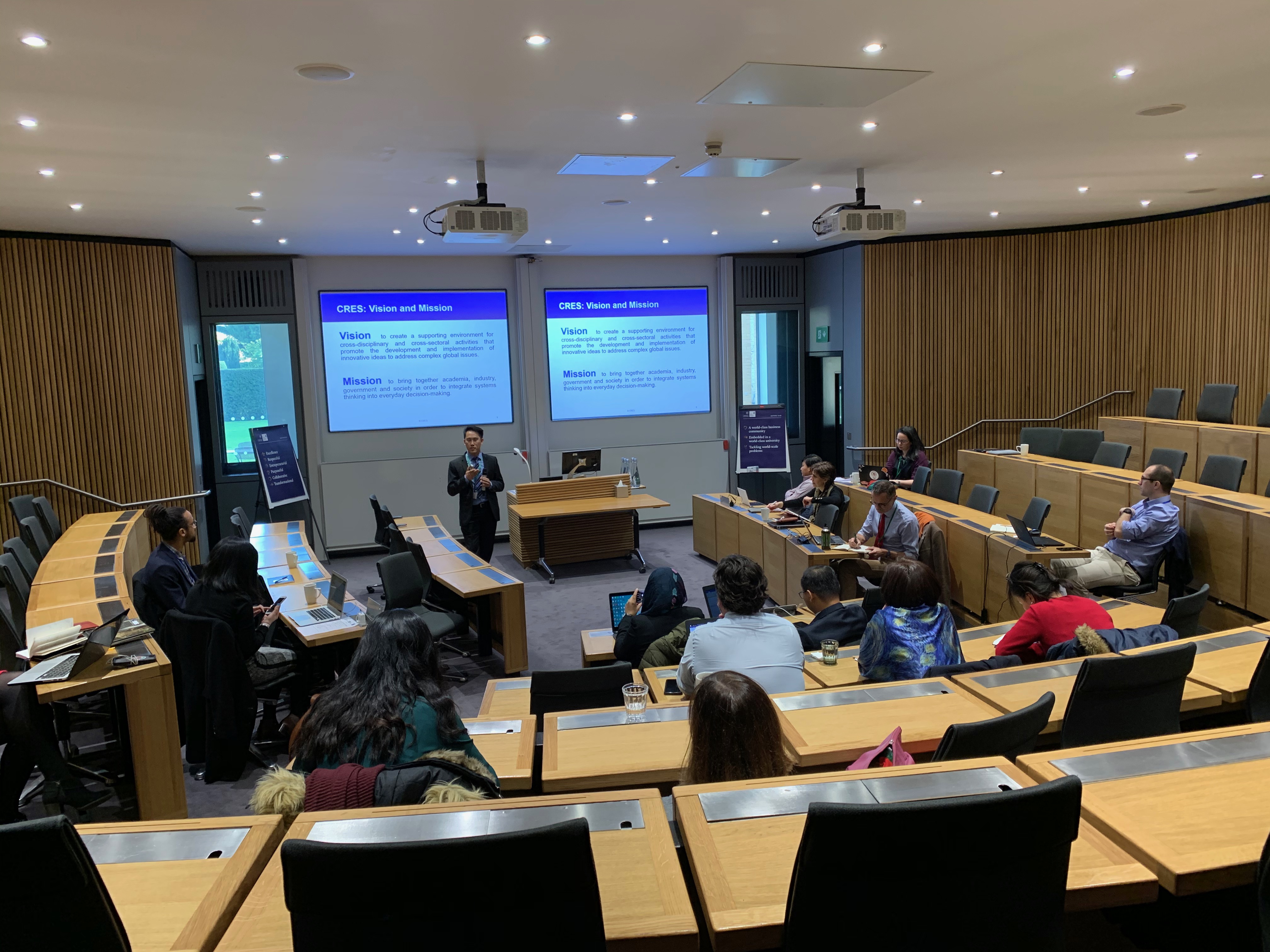
The vision of CRES is to bring together academia, industry, government and society in order to integrate systems thinking into everyday decision-making.
Mission
The mission of CRES is to create a supporting environment for cross-disciplinary and cross-sectoral activities that promote the development and implementation of innovative ideas to address complex global issues.
Strategic Objectives
We will deliver our mission through the following strategic objectives:
- Create a trans-disciplinary knowledge exchange platform in the area of sustainability to promote collaboration across academia and society and develop innovative ideas to solve complex global issues through communications and events.
- Identify gaps in knowledge and expertise that are hindering the implementation of sustainable solutions for environmental, societal and economic challenges.
- Provide education and training to students and practitioners in industry, government and the civil sector to a) Foster leadership in the fields of sustainability, environment and energy and b) Integrate systems thinking into decision-making; while remaining adaptive to respond to emerging demands for new sustainable systems expertise.
- Provide scientific evidence for strategic direction and solutions for sustainability challenges to policy makers, industry leaders and civil society.
Values
| Collaborative | Fostering communication across disciplines and sectors |
| Open | Being transparent and receptive to criticism and new ideas and perspectives |
| Innovative | Promoting the whole systems approach to sustainability |
| Inclusive | Embracing differences in approaches, norms, values and preferences |
| Rigorous | Applying scientific scrutiny to all proposed solutions |
| Supportive | Creating an effective platform for stimulating change |
CRES Team Structure

Events
Webinar Collection
CRES Webinar (01/2021) – Visualising Energy Resilience in Nepal
Chair: Dr. Katie Chong
Speakers: Dr. Long Seng To, Dr. Louise Reardon, Dr. Xinfang Wang, Dr. Asha Singh
Event Time and Date: 20 May 2021, 3PM (GMT+1)
A Participatory Approach for Visualising Energy Resilience in Nepal from a Whole-System Perspective
Understanding how and in what ways to foster resilience within energy systems is a complex issue, encapsulating a diversity of factors. This complexity creates barriers to effective decision-making towards resilience, where a whole-systems approach is required amidst a relatively siloed governance landscape.
To support decision making in this area, this talk discussed how a bottom-up participatory approach can be valuable in enabling decision-makers and key stakeholders to visualise the complexity of energy systems resilience, and in turn help facilitate the application of a whole-systems approach to the design of sustainable policy interventions towards more resilient systems.
The talk outlined the participatory causal loop mapping approach, highlight the method’s value in identifying the variables and visualising interconnections affecting energy resilience in Nepal, as a case study. Nepal has experienced energy supply disruption from both long-term energy supply deficiency and short-term shocks. The outcomes of our bottom-up participatory workshop with key stakeholders show the significant benefit of using this approach to enable participants visualising the complexity of energy systems resilience and creating a shared understanding of ways in which resilience can be improved.
CRES Webinar (02/2021) – Plastics: Friend or Foe?
Chair: Dr. David Tompkins
Speaker: Dr. Marloes Peeters
Event Time and Date: 6 July 2021, 3PM (GMT+1)
Plastics: Friend or Foe? Polymers for monitoring of environmental contaminants
Understanding how and in what ways to foster resilience within energy systems is a complex Molecularly Imprinted Polymers (MIPs) are porous materials that enable specific binding of their respective target molecules; while they mimic the affinity of natural recognition elements, they are low-cost, robust (can withstand extremes of pH and T), and can be used for templates as small as ions to large macromolecules. Furthermore, MIPs are produced using animal-free technology, an important aspect considering still 1 million animals are used in the EU per year and there is a current ban on use of animal-derived antibodies.
In this talk, I will show how we can integrate MIPs into modified screen-printed electrodes (MIP-modified SPEs) and use them for sensing of environmental contaminants. Specifically, I will talk about aspects of reusability and use of paper as substrate material to promote sustainability. The sensors are used to measure caffeine, an anthropogenic marker of water contamination, a range of antibiotics, and microorganisms to provide information about water quality. I will demonstrate both our standalone thermal sensor platform that is used for rapid screening of samples to more common techniques involving electrochemical detection. Our sensors can be used for fast and low-cost detection performed on-site considering the enhanced stability of the MIPs, which holds great potential for the determination of contaminants in environmental samples. Moreover, this is a platform technology and can be adapted to an array format containing a range of markers.
Gallery

 Biorefinery and Resource Recovery Research Group