New study highlights the techno-economic and environmental potential of Energy-from-Waste with Carbon Capture and Storage
Published: 10th July 2026
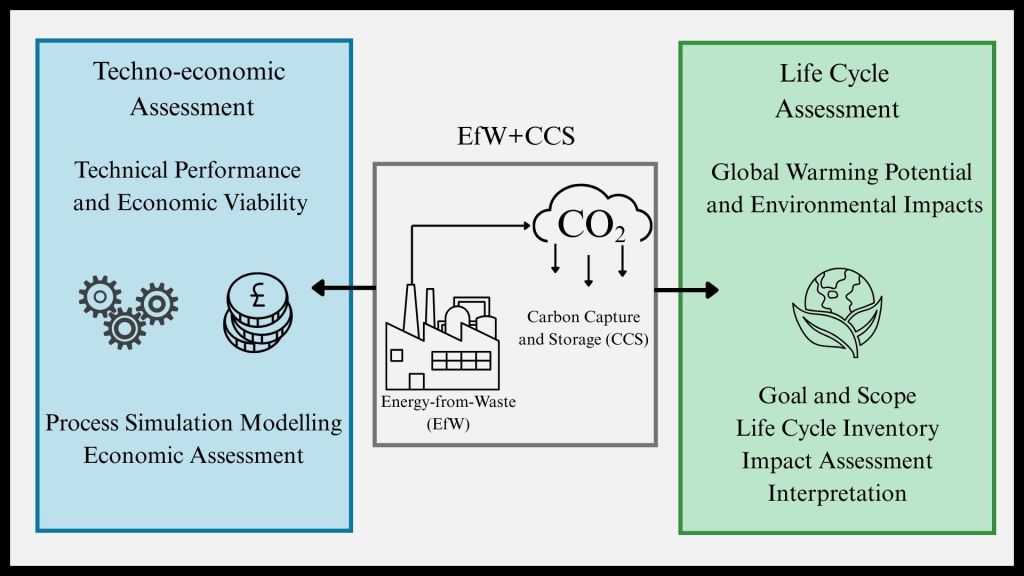
Doctoral researcher, Janna Aljoubory, has published a new study, in collaboration with Dr. Eleni Iacovidou and Dr. Kok Siew Ng, investigating the feasibility of integrating Carbon Capture and Storage (CCS) with Energy-from-Waste (EfW) facilities to reduce greenhouse gas emissions while maintaining economic viability. The paper, titled “A Comparative Techno-Economic and Life Cycle Assessment of Energy-from-Waste Technology Integrated with Carbon Capture and Storage,” provides a comprehensive evaluation of the environmental and economic implications of deploying CCS within modern EfW plants.
Background
Rapid urbanisation and global population growth are expected to nearly double municipal solid waste (MSW) generation by 2050. Energy-from-Waste technologies play an increasingly important role in sustainable waste management by recovering electricity and heat from non-recyclable waste streams. However, conventional EfW plants emit approximately 0.7–1.7 tonnes of CO₂ for every tonne of MSW processed, making decarbonisation essential if the sector is to contribute to national and international climate targets.
Integrating CCS with EfW facilities offers the opportunity to substantially reduce these emissions while generating reliable, low-carbon energy. Despite this potential, widespread deployment has been limited by high capital costs, increased operating expenditure, and reduced plant efficiency.
About the study
This research presents a comprehensive comparison between a conventional EfW plant and an EfW facility integrated with CCS using a combined techno-economic assessment (TEA) and life cycle assessment (LCA) framework.
A thermodynamic steady-state process model was developed in Aspen Plus to simulate both systems and evaluate mass and energy balances. Economic performance was assessed using key financial indicators, while environmental impacts were quantified through life cycle assessment across multiple impact categories.
Key findings
The analysis demonstrates that integrating CCS can significantly reduce greenhouse gas emissions, although notable technical and economic trade-offs remain.
Technical performance
- 250 ktpa EfW plant capacity with CCS
- 80% CO₂ capture efficiency
- Approximately 35% energy penalty compared with standalone EfW
Economic performance
- Capital expenditure (CAPEX) increased by 30%
- Operating expenditure (OPEX) increased by 30%
- Positive Net Present Value (NPV)
- Return on Investment (ROI): 2.7%
- Levelised Cost of Electricity (LCOE): £163/MWh
- Payback period increased from 4.5 years (standalone EfW) to 8.3 years (EfW + CCS)
Environmental performance
Life cycle assessment revealed that integrating CCS reduced the Global Warming Potential (GWP) by approximately 33%, demonstrating substantial climate benefits.
However, additional environmental burdens arose from the production of monoethanolamine (MEA) solvent and the construction of carbon capture infrastructure, increasing impacts in several non-climate categories.
Policy implications
The study indicates that current carbon pricing mechanisms are unlikely to provide sufficient financial incentives for CCS deployment in the EfW sector.
At the current carbon price of £49.4 per tonne of CO₂, CCS integration is not economically attractive. Economic modelling suggests that a support mechanism equivalent to approximately £178 per tonne of CO₂ captured would be required to encourage commercial adoption.
The research also highlights the importance of nitrogen oxide (NOₓ) control strategies. Increasing ammonia use to achieve 60% NOₓ removal reduced Global Warming Potential by 41%, increasing operating expenditure by 19% compared with conventional EfW.
Impact
The findings demonstrate that Energy-from-Waste integrated with Carbon Capture and Storage has significant potential to support net-zero ambitions by reducing emissions from the waste sector while continuing to generate reliable electricity and heat.
Although the technology remains economically challenging under current market conditions, the study identifies the policy support and technological improvements needed to enable wider deployment. The combined techno-economic and environmental framework developed in this work provides valuable evidence for policymakers, industry stakeholders, and researchers evaluating the future role of EfW+CCS in sustainable waste management and decarbonisation strategies.
Link to Paper:
Aljoubory, J., Iacovidou, E., Ng, K.S., 2026. J. Clean. Prod. 572: 148920.

